NSTA Resources

Novice

EarthScope Consortium is pleased to share a curated list of the free classroom-ready resources we featured at our booth during the National Science Teaching Association (NSTA) conference. This collection includes Earth and environmental science activities, interactive tools, classroom visuals, and educator supports designed to help teachers bring real-world geoscience into their curriculum, whether they're introducing foundational concepts or extending student investigations with authentic data and inquiry.

Explore the resources below to find materials that fit your grade level, time available, and teaching goals. Each item includes a brief overview and a direct link so you can quickly preview, download, and use it with students.


Keypoints:

These resources are:

  • Classroom-ready
  • Student-centered
  • Activity based
  • NGSS aligned
  • FREE
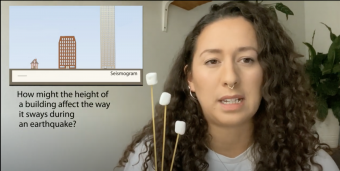
The rolling motion of a seismic wave may move at the same frequency of a building. The structure will then sway back and forth during the seismic vibration. A building's architectural design, height (how many stories), and construction materials affect resonance, or the seismic oscillation. Buildings engineered with earthquake shaking in mind will withstand resonance and serious damage.
Activities Novice
“What’s Inside the Earth?" is an interactive digital poster designed to engage learners in exploring the vital role seismic waves play in determining the composition and structure of Earth's interior. 
Interactive Novice
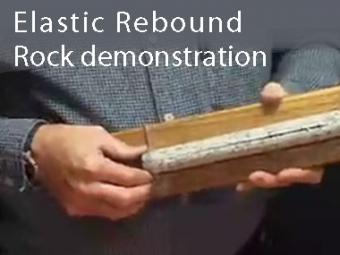
Through a demonstration lead by the teacher, the discrepant concept of rocks exhibiting elastic behavior is physically illustrated with an easily obtained, inexpensive model.
Lesson Novice
This demonstration shows that rocks are elastic by squeezing a slit core of rock.
Video Novice
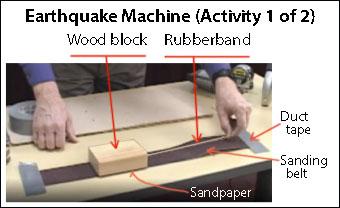
The Earthquake Machine is a simple model that helps learners visualize the inputs and outputs of an active fault system that leads to earthquakes. The Earthquake Machine introduces the basics physics of an earthquake. Instructors can use the activity for exploration or demonstration purposes.
Activities Novice
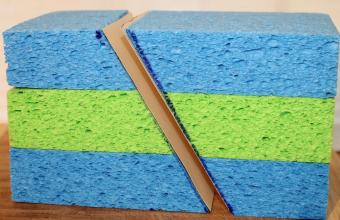
Fault types and rock deformation.  The faults and folds in rocks provide evidence that the rocks are subjected to compressional, tensional, and/or shear stress. Silly Putty™ allows students to discover that the structure we see in rocks provides evidence for they type of stress that formed. Students apply this idea by examining images of faults and folds experimentation with sponge models.
Lesson Novice
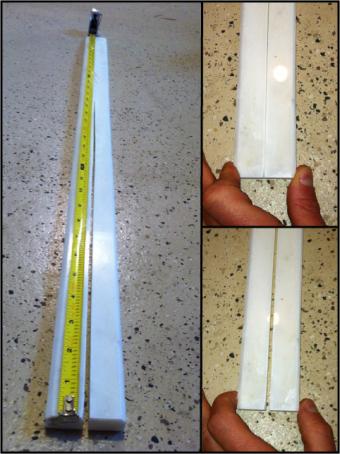
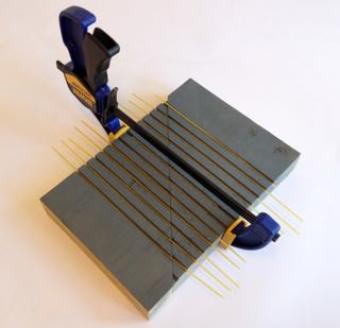
Squeezing uncooked spaghetti noodles in a wood template set in a bar clamp, effectively models how asperities (stuck patches) on a fault rupture at different times.
Lesson Novice
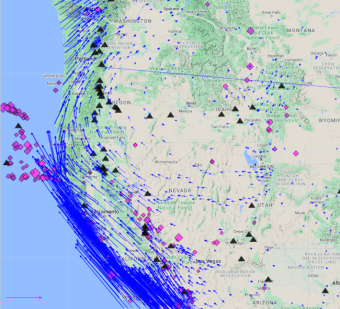
In this activity, learners explore ground deformation at and near plate boundaries using hand and body motions, data from GPS and maps. In the 5-minute activity, learners explore the concept of vectors by kinesthetically enacting ground movement using their body and hand movements. In the 20-minute activity, learners model GPS ground motion in different regions and connect deformation to earthquake hazards. In the 45-minute activity learners distinguish between different boundary types by measuring the vectors within tectonic plates and identify regions with higher earthquake hazards, comparing their findings to earthquake shaking potential maps.
Activities Novice
This interactive tool allows users to see GPS/GNSS-measured crustal motions around the globe in a wide range of reference frames.
Software-Web-App Novice
This animation shows how high-precision GPS networks help us understand plate tectonic motions and earthquake hazards around the world, with a focus on the Western United States. Developed for the Geodesy Tools for Societal Issues (GETSI) project with funding from the National Science Foundation.
Animation Novice
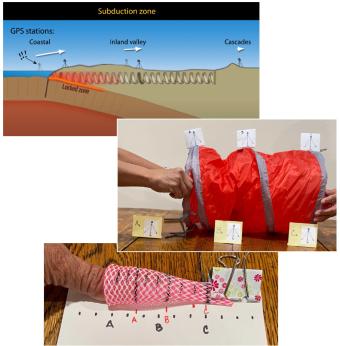
This set of hands-on activities helps students investigate ground deformation and earthquake hazards in the Pacific Northwest using physical models, real-world data, and map analysis. A brief demonstration with a compression spring illustrates how the subduction of the Juan de Fuca plate beneath the North American plate causes varying motion across the region. In longer activities, students measure compression, analyze GPS vector maps, and identify seismic hazard zones. By interpreting real-world data, students develop a deeper understanding of tectonic forces and connect these concepts to earthquake preparedness strategies.
Activities Novice
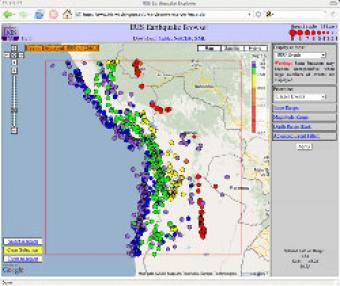
The IRIS Earthquake Browser (IEB) is an interactive tool for exploring millions of seismic event epicenters (normally earthquakes) on a map of the world. Selections of up to 5000 events can also be viewed in 3D and freely rotated with the 3D Viewer companion tool. 
Software-Web-App Novice
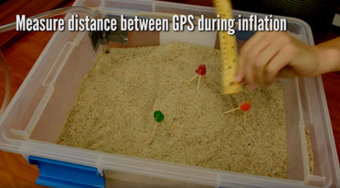
This hands-on demonstration illustrates how GPS can be used to measure the inflation and deflation of a volcano. Volcanoes may inflate when magma rises closer to the surface and deflate when the pressure dissipates or after an eruption.
Activities Novice
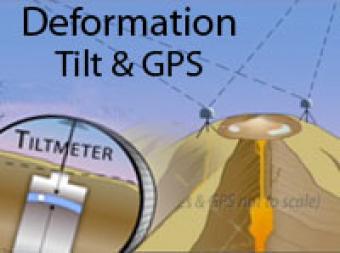
Volcano deformation can provide clues about what is happening deep below the surface. Two techniques used to monitor deformation include Tiltmeters and GPS.
Animation Novice
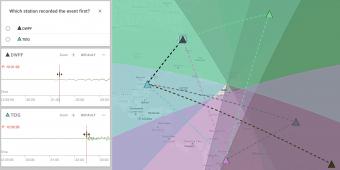
EqLocate is a suite of interactive apps giving users the opportunity to choose their preferred earthquake location method and specific earthquake they want to analyze. Through these easy-to-use tools, learners explore real data from recent and historic seismic events gaining valuable hands-on experience in earthquake locating techniques.
Software-Web-App Novice
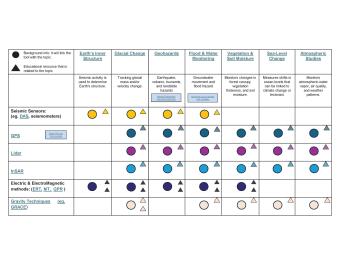
Geophysics, a multidisciplinary field, offers an engaging way to connect physics and Earth science concepts to real-world topics of interest to students. By
highlighting geophysical instruments, like GPS, lidar, and InSAR, educators can align lessons with Next Generation Science Standards (NGSS) while exploring relevant topics such as groundwater depletion, tectonic motion, and atmospheric studies.
Fact-Sheet Novice
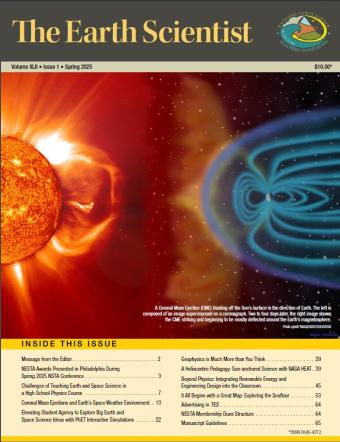
This issue of The Earth Scientist, the National Earth Science Teachers' Association's publication, highlights classroom resources focusing on cross-curricular topics of physics and earth science. EarthScope's contribution is on page 29 - "Geophysics is Much More than You Think" which offers geophysics/environmental science topics with links to resources and activities on waves, and the instrumentation used to study the topics.
Fact-Sheet Novice

We encourage the reuse and dissemination of the material on this site as long as attribution is retained. To this end the material on this site, unless otherwise noted, is offered under Creative Commons Attribution (CC BY 4.0) license